Correlation
Correlation: Advanced Atomistic Structural & Dynamic Analysis Suite







Correlation is a high-performance C++23 structural and dynamic analysis engine for atomistic simulations of liquids, amorphous solids, crystals, disordered networks, and soft-matter systems.
Built for modern HPC clusters and workstations, Correlation delivers multi-vendor GPU acceleration (CUDA, HIP, Intel oneAPI/SYCL), dynamic SIMD vectorization (AVX2, AVX-512), multi-threaded oneTBB scaling, memory-mapped multi-gigabyte trajectory parsing, a modern Slint GUI with multi-curve comparison overlays, and direct Python/PyTorch Geometric interoperability.
📑 Table of Contents
Correlation: Advanced Atomistic Structural \& Dynamic Analysis Suite
🌟 Key Capabilities
📊 Scientific Calculator Suite
Correlation computes an extensive array of spatial, radial, angular, topological, electronic, and dynamic properties:
| Category | Calculators & Functions | Output Properties |
|---|---|---|
| Radial / Pair | Radial Distribution Function ($J(r)$), Pair Distribution Function ($g(r)$), Reduced Pair Distribution ($G(r)$) | Total & partial pair correlations, coordination shells, density scaling |
| Scattering & Diffraction | Structure Factor ($S(Q) / S(K)$), Powder X-ray Diffraction (XRD) | Elastic scattering intensity, Faber-Ziman partials, Debye scattering equation |
| Angular Distributions | Plane-Angle Distribution (PAD), Dihedral-Angle Distribution (DAD), Generic Bond Angles | 3-body & 4-body angular configurations, tetrahedrality, dihedral orientation |
| Topology & Local Structure | Common Neighbor Analysis (CNA), Coordination Numbers (CN), Ring Distribution (RD), Voronoi Polyhedra, Cluster Connectivity, Motif Detection | FCC/HCP/BCC/Icosahedral classification, Voronoi index $\langle n_3, n_4, n_5, n_6 \rangle$, topological shortest-path ring statistics |
| Order Parameters & Symmetry | Steinhardt Bond-Orientational Parameters ($Q_4, Q_6, W_6$), Local Inversion Chirality, Local Excess Entropy ($s_2$), Hyperuniformity Index | Global/local orientational order, structural chirality asymmetry, two-body excess entropy, low-$Q$ density fluctuations |
| Dynamics & Transport | Mean Squared Displacement (MSD), Velocity Autocorrelation Function (VACF), Vibrational Density of States (VDOS) | Self-diffusion coefficients ($D_{MSD}, D_{VACF}$), relaxation time $\tau$, Deborah number $De$, vibrational power spectra |
| Spatial & Electronic / ML | 3D Spatial Distribution Functions (SDF), Hydrogen Bonding (HBond), Machine Learning Interatomic Potentials (MLIP) | 3D local coordinate voxel density, donor-acceptor geometric networks, LibTorch GNN evaluation, PyG graph construction |
📂 Comprehensive Format Support
Native high-speed parsing with content-based format sniffing (ReaderFactory) for automatic detection of extensionless or generic .in/.out files:
- Quantum Chemistry & DFT: VASP (
POSCAR,CONTCAR,XDATCAR), Quantum ESPRESSO (.pwi,.pwo,.in,.out), CP2K (.inp,.restart,.out), ORCA (.out), GPAW (.gpw), ABINIT (.abi), DFTB+ (.gen), CASTEP (.cell,.md), ONETEP (.dat), DMol³ / Materials Studio (.outmol,.car,.arc). - Classical Molecular Dynamics: LAMMPS (
.dump,.lammpstrj), GROMACS (.gro,.xtc,.trr), CHARMM / NAMD / Amber (.pdb,.ent). - Crystallography & Exchange: Extended XYZ (
.xyz,.exyz), Crystallographic Information (.cif). - Export Targets: High-throughput tabular and binary export in CSV, HDF5 (
.h5), Apache Arrow / Parquet (.parquet), SVG, PNG, and native vector PDF.
⚡ High-Performance Core & Multi-Vendor GPU
- Multi-Vendor GPU Acceleration: Unified GPU layer supporting NVIDIA (CUDA), AMD (HIP), and Intel (oneAPI / SYCL) for $S(Q)$, pairwise distance binning, Steinhardt order parameters, and XRD Debye scattering.
- SIMD Kernel Dispatch: Optimized runtime vector kernels utilizing AVX2, AVX-512, and scalar fallbacks.
- Configurable Precision (
real_t): Native compile-time toggle between single-precision (float) and double-precision (double) execution via-DUSE_SINGLE_PRECISION=ON/OFF. - Zero-Copy Memory-Mapped I/O:
MappedFilearchitecture allows instant lazy frame seeking across multi-gigabyte trajectories without memory exhaustion. - Numerical Stability: Project-wide Kahan compensated summation across numerical integrals, unwrapped trajectory tracking, and Debye scattering accumulators.
📦 Installation
Pre-compiled Packages
Download pre-built executables and installers from the GitHub Releases page:
- Linux: Portable
AppImage, Debian/Ubuntu.deb, Fedora/RHEL/openSUSE.rpm - macOS: Universal
.dmg - Windows: Standalone
.exeinstaller
Conda-Forge / Pixi
Install the CLI and Python package via conda-forge:
# Using Conda / Mamba
conda install -c conda-forge correlation

# Using Pixi
pixi add correlation
Building from Source
Prerequisites
- C++ Compiler: Modern C++ compiler supporting C++23 (GCC 13+, Clang 16+, MSVC 2022+)
- CMake: Version 3.24 or higher
- Ninja or Make
- Rust & Cargo: (Required for Slint GUI compilation)
- Intel oneTBB: Threading Building Blocks development headers
- Optional: HDF5 (
libhdf5-dev), Apache Arrow (libarrow-dev), FFTW3 (libfftw3-dev), CUDA Toolkit (12.0+) / Intel oneAPI DPC++.
Step-by-Step Build
# 1. Clone the repository
git clone https://github.com/Isurwars/Correlation.git
cd Correlation

# 2. Configure build with CMake
cmake -B build -G Ninja \
  -DCMAKE_BUILD_TYPE=Release \
  -DBUILD_GUI=ON \
  -DBUILD_PYTHON_BINDINGS=ON

# 3. Compile
cmake --build build -j$(nproc)

# 4. Execute test suite (700+ tests)
ctest --test-dir build --output-on-failure
CMake Build Options
| CMake Flag | Default | Description |
|---|---|---|
BUILD_GUI |
ON |
Compiles the Slint-based Graphical User Interface (src/correlation) |
BUILD_PYTHON_BINDINGS |
OFF |
Compiles Python C-extension bindings via pybind11 |
USE_SINGLE_PRECISION |
OFF |
Compiles core algorithms using single-precision float (real_t) |
BUILD_WITH_CUDA |
OFF |
Enables NVIDIA CUDA GPU acceleration kernels |
BUILD_WITH_SYCL |
OFF |
Enables Intel oneAPI / SYCL multi-vendor GPU acceleration |
BUILD_WITH_HDF5 |
OFF |
Enables HDF5 consolidated binary export format |
BUILD_WITH_ARROW |
OFF |
Enables Apache Arrow / Parquet columnar export format |
BUILD_WASM |
OFF |
Compiles WebAssembly client-side library bindings |
CORRELATION_ENABLE_LIBTORCH |
OFF |
Links LibTorch for native GNN MLIP evaluation |
🚀 Usage Modes
1. Graphical User Interface (GUI)
Launch the modern Slint-based interface:
./build/src/correlation
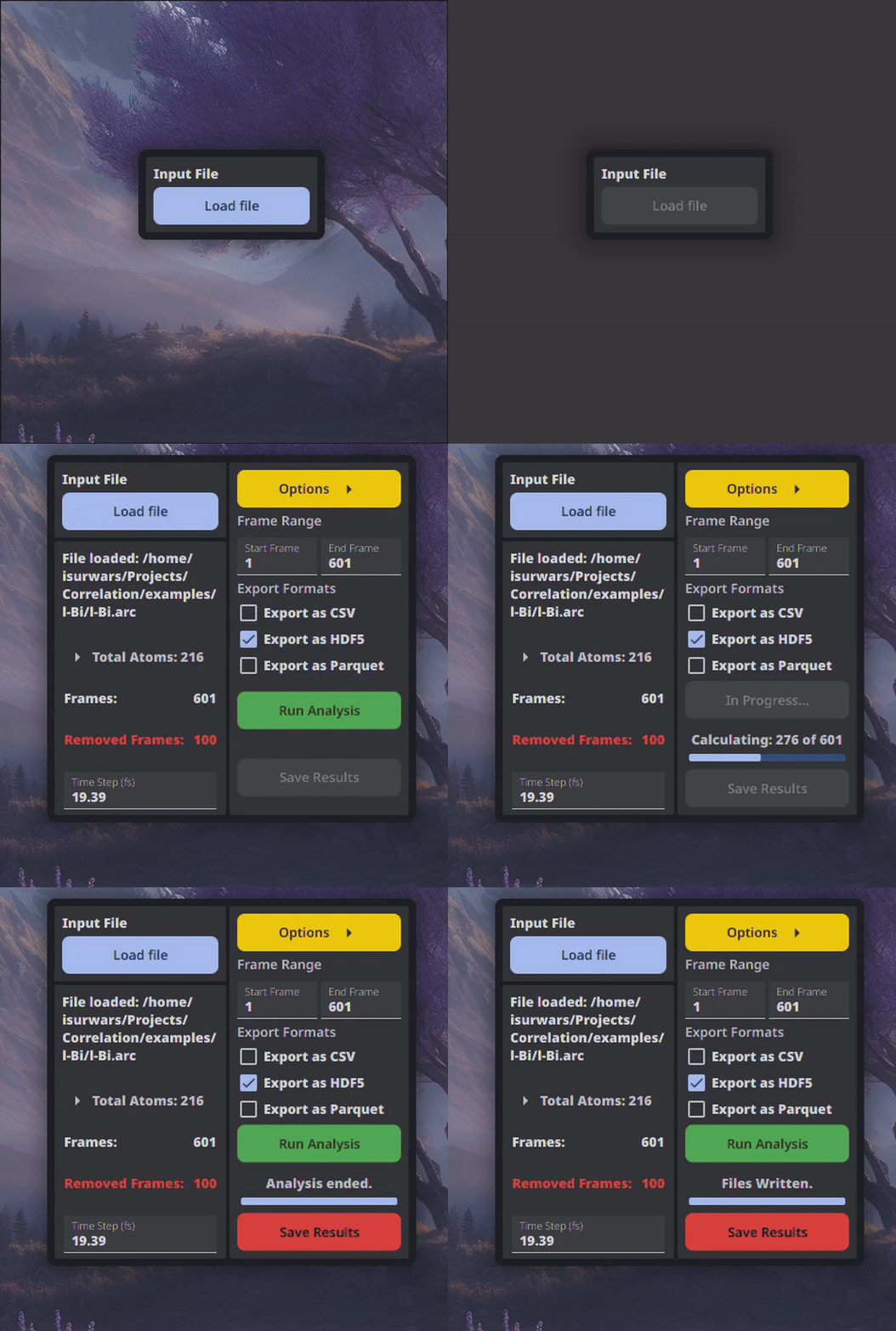
Key GUI Highlights:
- Interactive 3-Column Layout: Seamlessly navigate between structure setup, parameter cards, bond cutoff matrices, and live plot rendering.
- Multi-Curve Comparison Overlay: Load and overlay multiple datasets or trajectories simultaneously, compute dynamic difference plots ($Y_{Diff} = Y_1 - Y_2$), and customize individual styles, dashes, and color palettes.
- Vector Publication Export: Export high-resolution plots directly to SVG, PNG, or native PDF with embedded normalized vector fonts and Greek character glyphs.
- Preset Configuration Manager: Save and load custom analysis presets for liquid, crystalline, or amorphous simulations.
2. Command Line Interface (CLI)
Execute headlessly in automated cluster pipelines using correlation-cli:
# Analyze RDF, CNA, and MSD from a VASP trajectory with HDF5 and CSV output
correlation-cli Trajectory.xdatcar -o ./output/run_1 \
  --calculators RDF,CNA,MSD \
  --r-max 15.0 --r-bin 0.02 \
  --time-step 1.5 \
  --csv --hdf5
Core CLI Arguments:
| Flag | Parameter | Description |
| :—————————– | :——– | :————————————————————————- |
| -o, --output | <path> | Base output path (default: input file stem) |
| --calculators | <list> | Comma-separated list of calculators to execute (e.g. RDF,XRD,PAD,CNA) |
| --r-max, --r-bin | <float> | Maximum radius ($Å$) and bin width ($Å$) for radial calculations |
| --q-max, --q-bin | <float> | Maximum scattering vector $Q$ ($Å^{-1}$) and bin width for $S(Q)$ |
| --angle-bin | <float> | Angular bin width in degrees for PAD/DAD (default: 1.0) |
| --max-ring-size | <int> | Maximum topological ring size to evaluate (default: 8) |
| --time-step | <float> | Simulation timestep in femtoseconds (default: 1.0) |
| --min-frame, --max-frame | <int> | 1-based frame evaluation range (-1 for all frames) |
| --smoothing-kernel | <str> | Smoothing filter: gaussian, bump, or triweight (default: gaussian) |
| --csv, --hdf5, --parquet | | Toggle tabular CSV, consolidated HDF5, or Apache Parquet output |
3. Python Bindings & PyTorch Geometric
Integrate Correlation directly into Python data-science environments, NumPy pipelines, and GNN frameworks:
import correlation
import numpy as np

# 1. Load atomistic structure or trajectory
cell = correlation.Cell.from_file("POSCAR")

# 2. Configure structural analysis engine
df = correlation.DistributionFunctions(cell, cutoff=10.0)

# 3. Compute radial and angular distribution functions
df.calculate_rdf(r_max=12.0, bin_width=0.05)
df.calculate_pad(bin_width=1.0)

# 4. Access computed histograms and partials
gr_hist = df.get_histogram("g_r")
bins = gr_hist.bins            # NumPy float array
total_gr = gr_hist.partials["Total"]

print(f"Computed {len(bins)} bins for g(r). Peak value: {np.max(total_gr):.3f}")

# 5. Build periodic graph & convert to PyTorch Geometric Data
graph_data = correlation.build_periodic_graph(cell, cutoff=5.0)
pyg_data = correlation.to_torch_geometric(graph_data)

print(pyg_data)
# Data(pos=[N, 3], z=[N], edge_index=[2, E], edge_shift=[E, 3], edge_vec=[E, 3], cell=[3, 3], pbc=[3])
👥 Authors & Citation
Corresponding Author
- Isaías Rodríguez — Isurwars isurwars@gmail.com
Contributors & Co-Authors
- Flor B. Quiroga quiroga.acbg@ciencias.unam.mx
- Renela M. Valladares renelavalladares@gmail.com
- Salvador Villarreal Lopez Rebuelta salvadorvillarreallr@gmail.com
- Alexander Valladares valladar@ciencias.unam.mx
- David Hinojosa-Romero david18_hr@ciencias.unam.mx
- Ulises Santiago
- Ariel A. Valladares valladar@unam.mx
Citation
If you use Correlation in scientific publications, please cite:
@article{Rodriguez2021Correlation,
  doi = {10.21105/joss.02976},
  url = {https://doi.org/10.21105/joss.02976},
  year = {2021},
  publisher = {The Open Journal},
  volume = {6},
  number = {59},
  pages = {2976},
  author = {Isa{\'i}as Rodr{\'i}guez and David Hinojosa-Romero and Alexander Valladares and Renela M. Valladares and Ariel A. Valladares},
  title = {Correlation: An Analysis Tool for Liquids and for Amorphous Solids},
  journal = {Journal of Open Source Software}
}
📜 License
Correlation is free and open-source software licensed under the GNU Affero General Public License v3 (AGPL-3.0-only). See LICENSE for details.
🙏 Acknowledgments
- I.R. acknowledges SECIHTI and DGAPA-UNAM for postdoctoral fellowship support.
- D.H.R. acknowledges DGAPA-UNAM for postdoctoral fellowship support.
- A.A.V., R.M.V., and A.V. thank DGAPA-UNAM for continued financial support (Grant Nos. IN104617, IN116520, IN118223, and IN119226).
- A.A.V., R.M.V., A.V., and I.R. acknowledge SECIHTI for research project grant support (Grant No. CBF-2025-G-886).
- Simulations and benchmarks were partially conducted at the Supercomputing Center of DGTIC-UNAM and IIM-UNAM.
- Special gratitude to M. A. Carrillo, R. S. Vilchis, S. Calderón, A. de Leon, J. A. Albarran, David A. de Jesús, and A. Perez-Aguiar for testing, benchmarking structures, and feedback.