Utility class for finding structural motifs (rings) in a system. More...
#include <MotifFinder.hpp>
Static Public Member Functions | |
| static std::map< int, size_t > | findRings (const correlation::core::NeighborGraph &graph, size_t max_size=6) |
| Finds and counts all chordless rings up to a maximum size using King's criterion. | |
| static std::map< int, size_t > | findFranzblauRings (const correlation::core::NeighborGraph &graph, size_t max_size=6) |
| Finds and counts all Franzblau shortest-path primitive rings up to a maximum size. | |
| static std::map< int, size_t > | findRings (const correlation::core::NeighborGraph &graph, size_t max_size, RingType ring_type) |
| Finds and counts all rings according to the specified ring criterion. | |
| static std::vector< std::vector< correlation::core::AtomID > > | extractCycles (const correlation::core::NeighborGraph &graph, size_t target_size) |
| Extracts all exact cycles of a specific target size using King's criterion. | |
| static std::vector< std::vector< correlation::core::AtomID > > | extractFranzblauCycles (const correlation::core::NeighborGraph &graph, size_t target_size) |
| Extracts all exact cycles of a specific target size using Franzblau's criterion. | |
| static std::vector< std::vector< correlation::core::AtomID > > | extractCycles (const correlation::core::NeighborGraph &graph, size_t target_size, RingType ring_type) |
| Extracts all exact cycles of a specific target size according to the ring criterion. | |
| static std::vector< std::vector< correlation::core::AtomID > > | extractAllCycles (const correlation::core::NeighborGraph &graph, size_t max_size, RingType ring_type=RingType::King) |
| Extracts all exact cycles up to a maximum size according to the ring criterion. | |
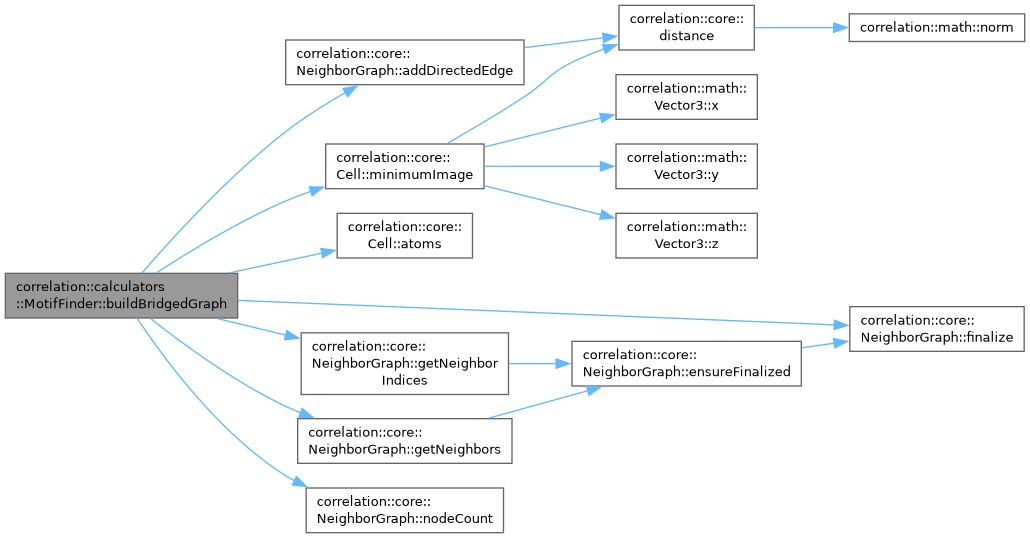
| static correlation::core::NeighborGraph | buildBridgedGraph (const correlation::core::NeighborGraph &graph, const correlation::core::Cell &cell, std::string_view former_element, std::string_view bridging_element) |
| Builds a projected neighbor graph collapsing bridging atoms (e.g. Si-O-Si -> Si-Si). | |
| static std::vector< std::vector< correlation::core::AtomID > > | filterAlternatingCycles (const std::vector< std::vector< correlation::core::AtomID > > &cycles, const correlation::core::Cell &cell, std::string_view element_a, std::string_view element_b) |
| Filters cycle list to retain only cycles strictly alternating between two elements. | |
Detailed Description
Utility class for finding structural motifs (rings) in a system.
This class provides static methods to search for and count chordless rings within a molecular system, leveraging the neighbor graph structure. Supports both King shortest-distance rings and Franzblau unique-geodesic primitive rings.
Member Function Documentation
◆ buildBridgedGraph()
|
staticnodiscard |
Builds a projected neighbor graph collapsing bridging atoms (e.g. Si-O-Si -> Si-Si).
In network glasses such as SiO2, this constructs an adjacency graph purely among network-former atoms that share a common bridging atom.
- Parameters
-
[in] graph The underlying atomic neighbor graph. [in] cell The atomic cell containing element species and positions. [in] former_element Chemical symbol of network-former (e.g. "Si"). [in] bridging_element Chemical symbol of bridging species (e.g. "O").
- Returns
- A new NeighborGraph linking former atoms.
◆ extractAllCycles()
|
staticnodiscard |
Extracts all exact cycles up to a maximum size according to the ring criterion.
- Parameters
-
[in] graph The neighbor graph to search. [in] max_size The maximum ring size to extract. [in] ring_type The ring criterion (King or Franzblau).
- Returns
- A vector of all detected rings.

◆ extractCycles() [1/2]
|
staticnodiscard |
Extracts all exact cycles of a specific target size using King's criterion.
- Parameters
-
[in] graph The neighbor graph to search. [in] target_size The exact size of the rings to extract.
- Returns
- A vector of rings, where each ring is represented as a vector of AtomIDs in order.

◆ extractCycles() [2/2]
|
staticnodiscard |
Extracts all exact cycles of a specific target size according to the ring criterion.
- Parameters
-
[in] graph The neighbor graph to search. [in] target_size The exact size of the rings to extract. [in] ring_type The ring criterion (King or Franzblau).
- Returns
- A vector of rings.
◆ extractFranzblauCycles()
|
staticnodiscard |
Extracts all exact cycles of a specific target size using Franzblau's criterion.
- Parameters
-
[in] graph The neighbor graph to search. [in] target_size The exact size of the rings to extract.
- Returns
- A vector of rings, where each ring is represented as a vector of AtomIDs in order.

◆ filterAlternatingCycles()
|
staticnodiscard |
Filters cycle list to retain only cycles strictly alternating between two elements.
For example in SiO2, retains rings whose sequence is Si-O-Si-O...
- Parameters
-
[in] cycles List of extracted atomic cycles. [in] cell The atomic cell containing element species. [in] element_a First element in alternating sequence. [in] element_b Second element in alternating sequence.
- Returns
- Filtered vector of alternating cycles.

◆ findFranzblauRings()
|
staticnodiscard |
Finds and counts all Franzblau shortest-path primitive rings up to a maximum size.
- Parameters
-
[in] graph The neighbor graph representing atomic bonds. [in] max_size The maximum ring size (number of atoms) to search for.
- Returns
- A map where the key is the ring size and the value is the total count.

◆ findRings() [1/2]
|
staticnodiscard |
Finds and counts all rings according to the specified ring criterion.
- Parameters
-
[in] graph The neighbor graph representing atomic bonds. [in] max_size The maximum ring size to search for. [in] ring_type The ring criterion (King or Franzblau).
- Returns
- A map where the key is the ring size and the value is the total count.
◆ findRings() [2/2]
|
staticnodiscard |
Finds and counts all chordless rings up to a maximum size using King's criterion.
- Parameters
-
[in] graph The neighbor graph representing atomic bonds. [in] max_size The maximum ring size (number of atoms) to search for.
- Returns
- A map where the key is the ring size and the value is the total count.

The documentation for this class was generated from the following files:
- include/calculators/spatial/MotifFinder.hpp
- src/calculators/spatial/MotifFinder.cpp