Loading...
Searching...
No Matches
correlation::core Namespace Reference
Namespaces | |
| namespace | gpu |
Classes | |
| struct | ElementID |
| Represents a unique integer ID for an element type. More... | |
| struct | Element |
| Represents a chemical element with its symbol and unique ID. More... | |
| class | ElementPool |
| Thread-safe flyweight pool for chemical Element instances. More... | |
| class | Atom |
| Represents an atom in the simulation cell. More... | |
| class | BondCutoffEngine |
| Domain engine responsible for computing, validating, and querying chemical bond cutoffs. More... | |
| class | Cell |
| Represents the simulation cell (periodic box). More... | |
| class | MappedFile |
| RAII memory-mapped read-only file view. More... | |
| struct | AtomIndex |
| Strong type wrapper representing an atom index. More... | |
| struct | Neighbor |
| Represents a neighbor atom in a neighbor list. More... | |
| struct | Edge |
| Represents a directed edge connecting two atoms in the graph. More... | |
| class | NeighborGraph |
| Compressed Sparse Row (CSR) based graph representing atomic connectivity. More... | |
| class | Trajectory |
| This class stores a series of snapshots of a system. More... | |
| class | TrajectoryFilter |
| Domain filter responsible for removing duplicate or invalid frames from a trajectory sequence. More... | |
| class | VelocityIntegrator |
| Domain calculator responsible for finite-difference velocity calculation under periodic boundary conditions. More... | |
Typedefs | |
| using | AtomID = std::uint32_t |
| Unsigned integer type used for unique atom identification. | |
Functions | |
| real_t | distance (const Atom &atom_a, const Atom &atom_b) noexcept |
| Calculates the Euclidean distance between two atoms. | |
| real_t | angle (const Atom ¢er, const Atom &atom_a, const Atom &atom_b) noexcept |
| Calculates the angle (in radians) formed by three atoms. | |
Variables | |
| constexpr std::uint64_t | K_MAX_TRAJECTORY_BYTES |
| Maximum trajectory file size (4 GiB). | |
Typedef Documentation
◆ AtomID
| using correlation::core::AtomID = std::uint32_t |
Unsigned integer type used for unique atom identification.
Function Documentation
◆ angle()
|
inlinenodiscardnoexcept |
Calculates the angle (in radians) formed by three atoms.
- Parameters
-
[in] center The atom at the vertex of the angle. [in] atom_a One of the outer atoms. [in] atom_b The other outer atom.
- Returns
- The angle in radians, or 0.0 if vectors are collinear or zero.
Here is the call graph for this function:

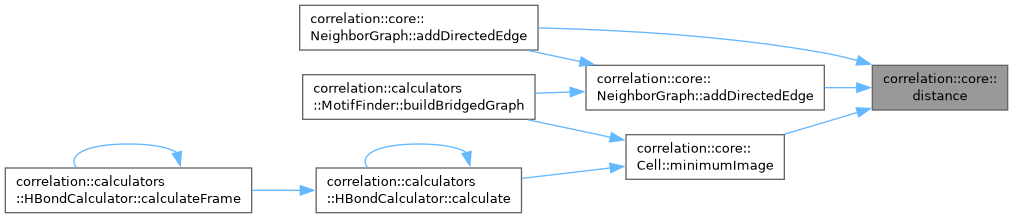
◆ distance()
|
inlinenodiscardnoexcept |
Calculates the Euclidean distance between two atoms.
- Parameters
-
[in] atom_a The first atom. [in] atom_b The second atom.
- Returns
- The straight-line distance between atoms (not accounting for PBC).
Here is the call graph for this function:

Here is the caller graph for this function:
Variable Documentation
◆ K_MAX_TRAJECTORY_BYTES
|
inlineconstexpr |
Initial value:
=
static_cast<std::uint64_t>(4) * 1024 * 1024 * 1024
Maximum trajectory file size (4 GiB).