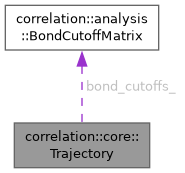
This class stores a series of snapshots of a system. More...
#include <Trajectory.hpp>
Classes | |
| struct | MappedFrameSlice |
Public Member Functions | |
Accessors | |
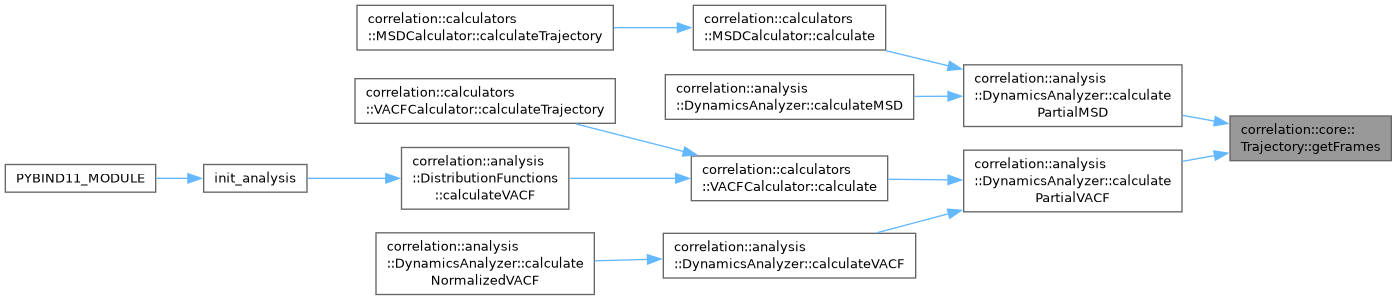
| std::vector< Cell > & | getFrames () |
| Gets a mutable reference to the frames. | |
| const std::vector< Cell > & | getFrames () const |
| Gets a constant reference to the frames. | |
| std::span< Cell > | frameSpan () |
| Gets a mutable span view over the trajectory frames. | |
| std::span< const Cell > | frameSpan () const |
| Gets an immutable span view over the trajectory frames. | |
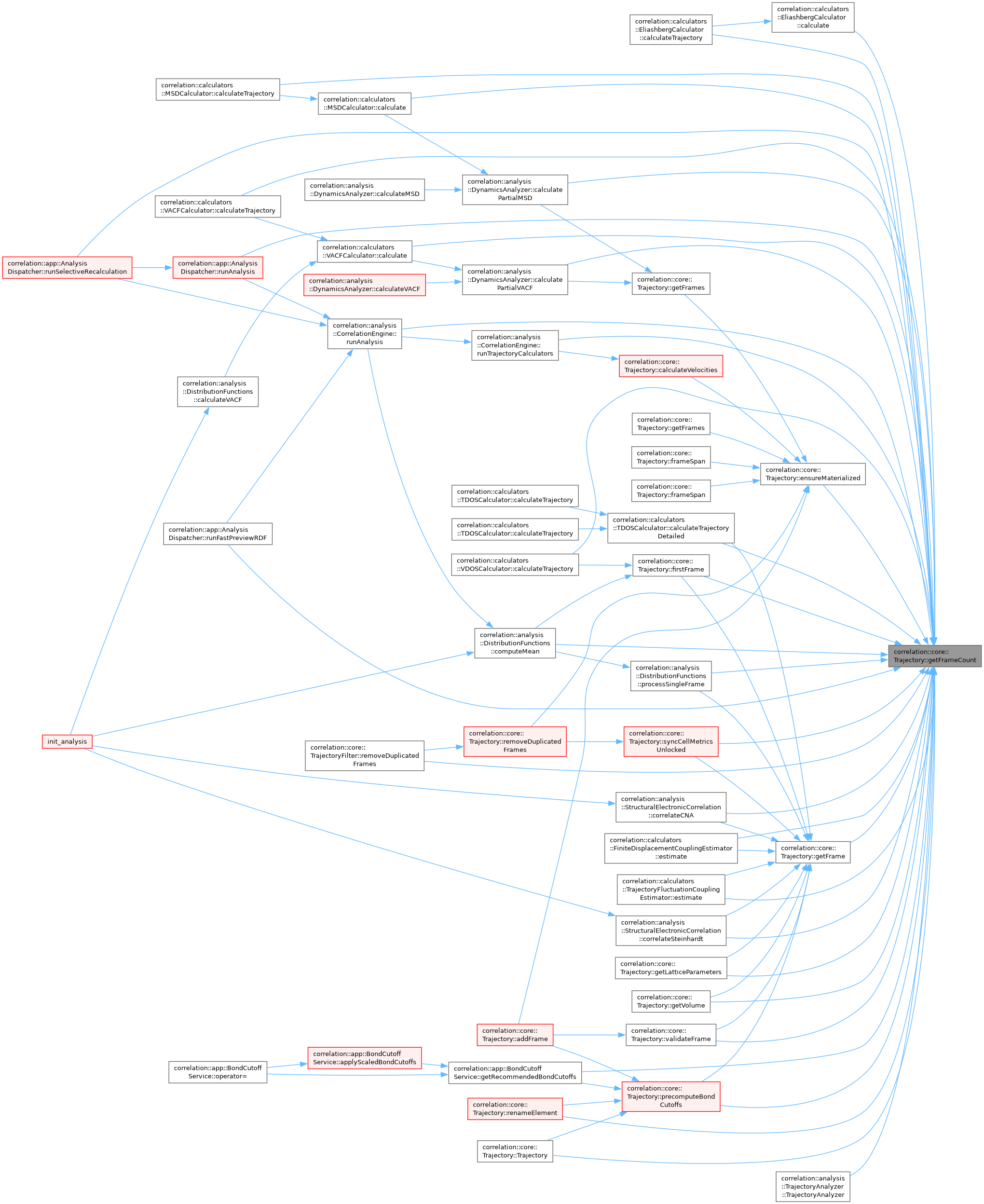
| size_t | getFrameCount () const noexcept |
| Gets the total number of frames in the trajectory. | |
| const Cell & | firstFrame () const |
| Gets a constant reference to the first frame of the trajectory. | |
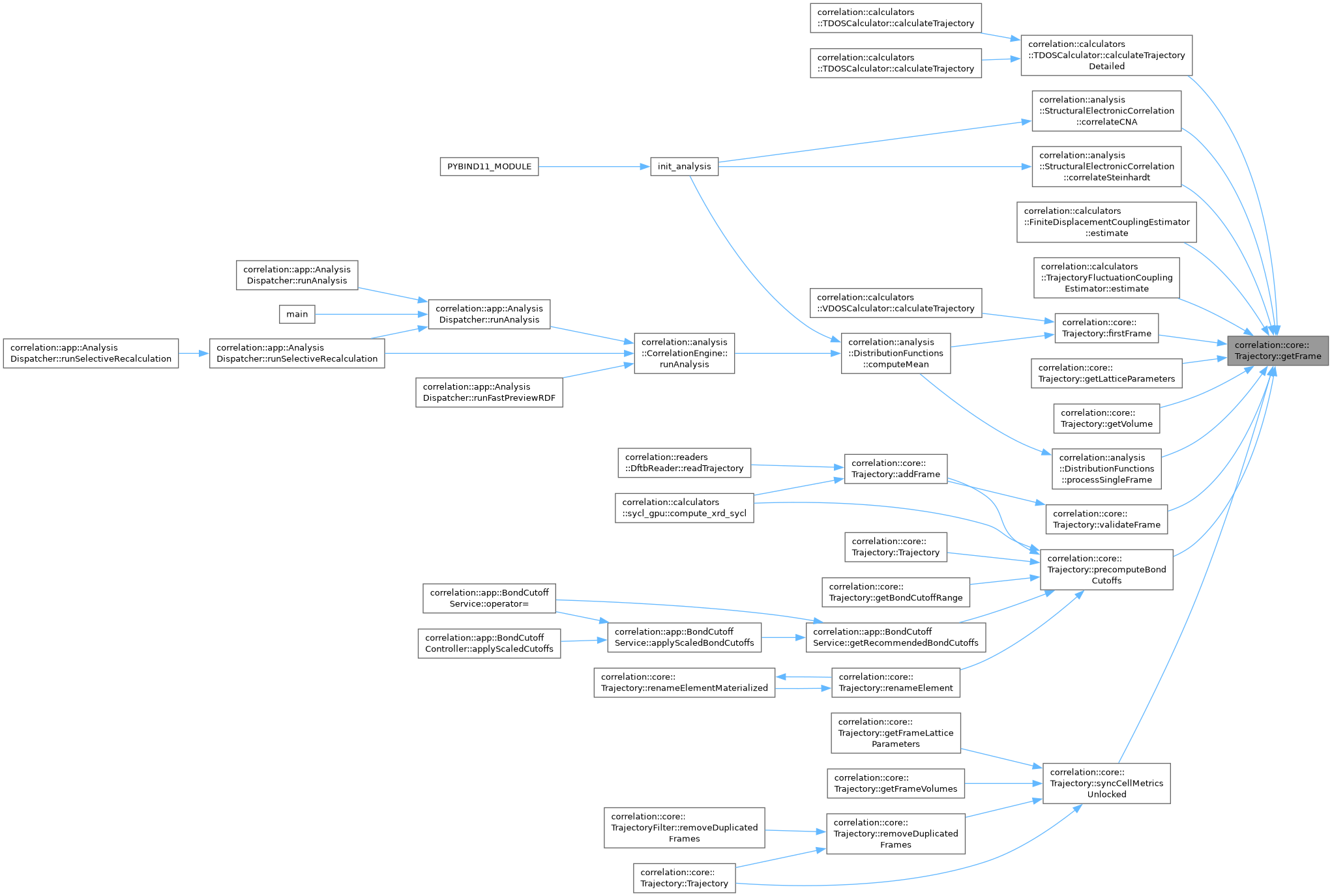
| Cell | getFrame (size_t index) const |
| Gets a copy of a frame at a specific index. | |
| std::array< real_t, 6 > | getLatticeParameters (size_t index) const |
| Gets the lattice parameters [a, b, c, alpha, beta, gamma] for a specific frame. | |
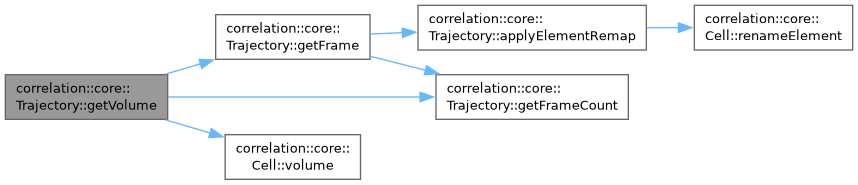
| real_t | getVolume (size_t index) const |
| Gets the simulation cell volume for a specific frame. | |
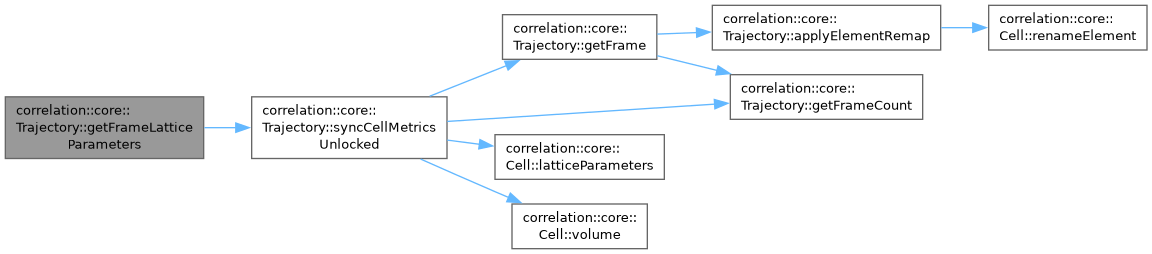
| const std::vector< std::array< real_t, 6 > > & | getFrameLatticeParameters () const |
| Gets the tracked lattice parameters [a, b, c, alpha, beta, gamma] for all frames. | |
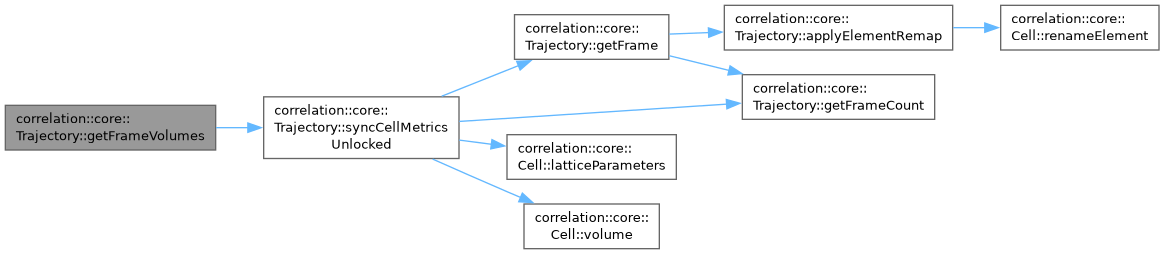
| const std::vector< real_t > & | getFrameVolumes () const |
| Gets the tracked cell volumes for all frames. | |
| real_t | getTimeStep () const noexcept |
| Gets the time step between frames. | |
| void | setTimeStep (real_t step) noexcept |
| Sets the simulation time step. | |
| const correlation::analysis::BondCutoffRange & | getBondCutoffRange (size_t type1, size_t type2) const |
| Gets the bond cutoff range for two given element types. | |
| real_t | getBondCutoffSQ (size_t type1, size_t type2) const |
| Gets a squared bond cutoff distance for two given element types. | |
| real_t | getMinBondCutoffSQ (size_t type1, size_t type2) const |
| Gets a squared minimum bond cutoff distance for two given element types. | |
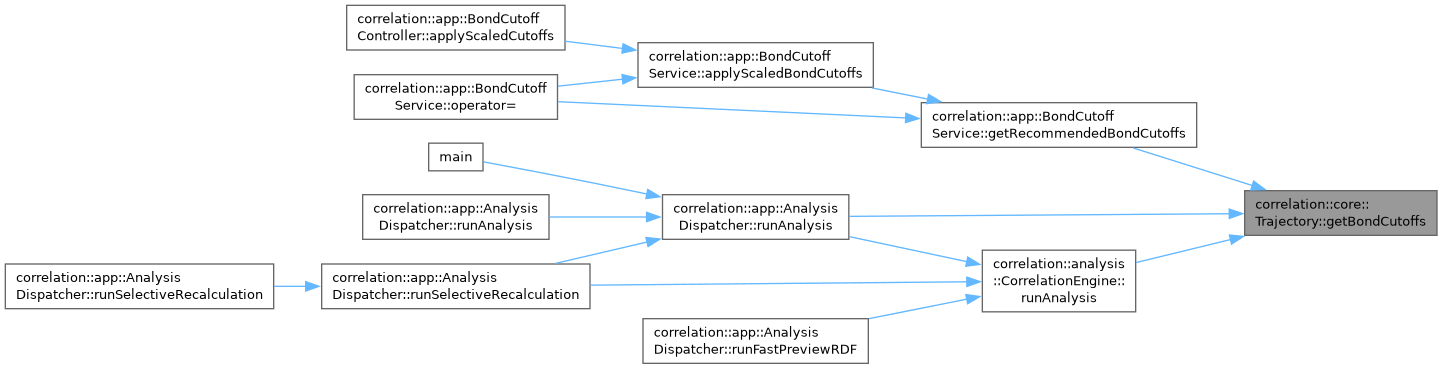
| real_t | getBondCutoff (size_t type1, size_t type2) const |
| Gets the maximum bond cutoff distance for two given element types. | |
| real_t | getMinBondCutoff (size_t type1, size_t type2) const |
| Gets the minimum bond cutoff distance for two given element types. | |
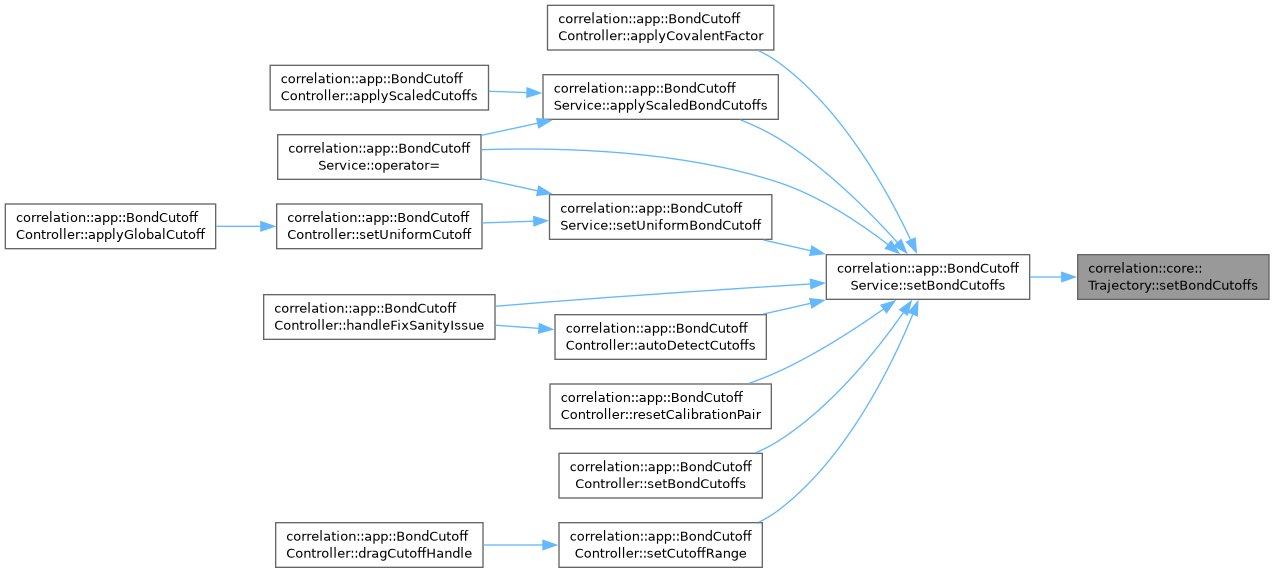
| void | setBondCutoffs (const correlation::analysis::BondCutoffMatrix &cutoffs) |
| Sets the bond cutoff matrix for neighbor searching. | |
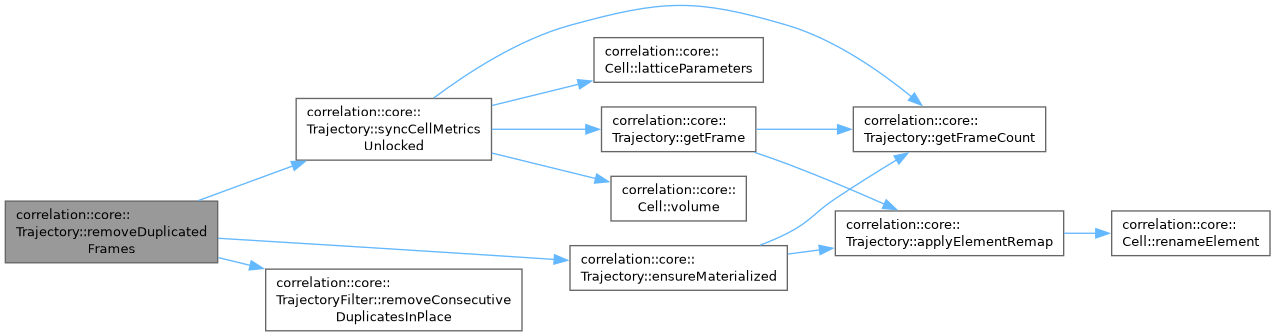
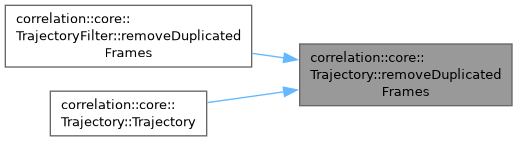
| void | removeDuplicatedFrames (real_t tolerance=static_cast< real_t >(1e-5)) |
| Removes consecutive duplicated frames from the trajectory. Frames are considered duplicates if all atom positions are identical (within a small tolerance). | |
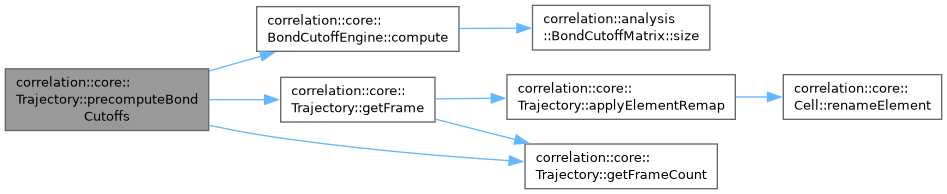
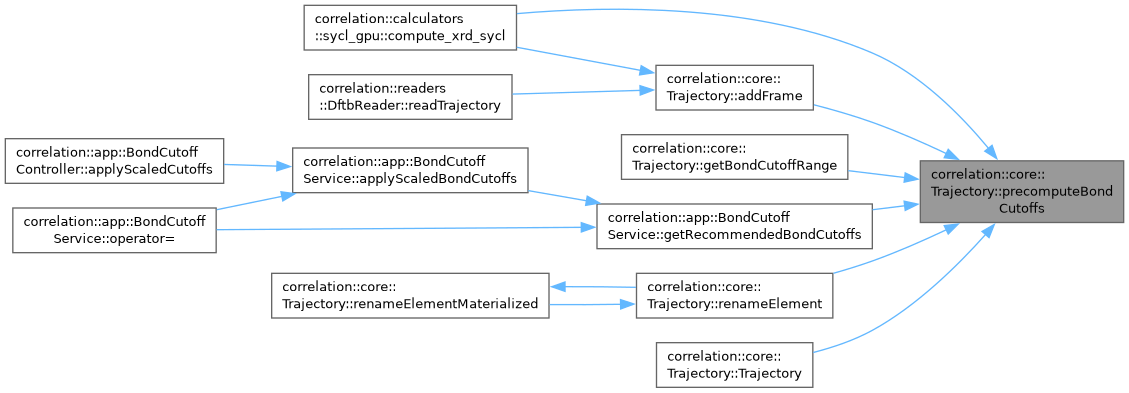
| void | precomputeBondCutoffs () const |
| Pre-calculates the squared bond cutoff distances for every pair of element types using the elements from the first frame. | |
| void | calculateVelocities () |
| Calculates velocities for all atoms in the trajectory using finite differences, accounting for periodic boundary conditions. Assumes constant time step. Populates the internal velocities_ vector. | |
| const correlation::analysis::BondCutoffMatrix & | getBondCutoffs () const noexcept |
| Gets the matrix of bond cutoff ranges for element pairs. | |
| const correlation::analysis::BondCutoffMatrix & | getBondCutoffsSQ () const noexcept |
| Backward-compatible alias returning the bond cutoff matrix. | |
| size_t | getRemovedFrameCount () const noexcept |
| Returns the number of frames removed during deduplication. | |
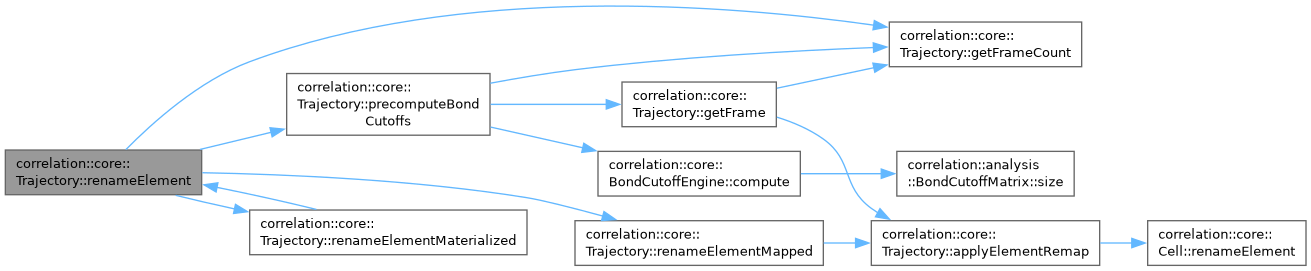
| bool | renameElement (std::string_view old_symbol, std::string_view new_symbol) |
| Renames an element species across all frames (both materialized and lazy-mapped) and recomputes bond cutoffs. | |
Private Member Functions | |
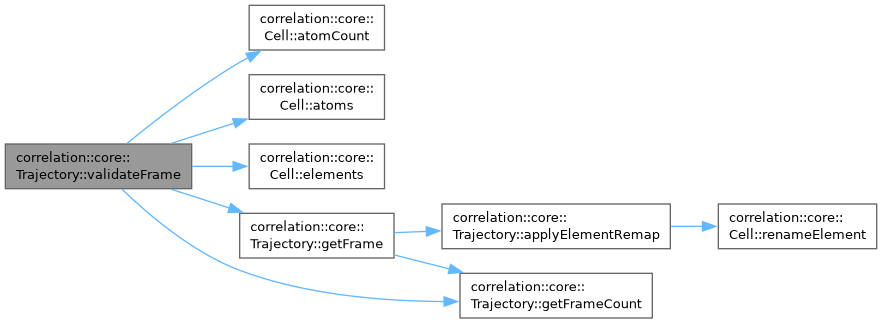
| void | validateFrame (const Cell &new_frame) const |
| Internal helper to validate that a new frame matches the trajectory topology. | |
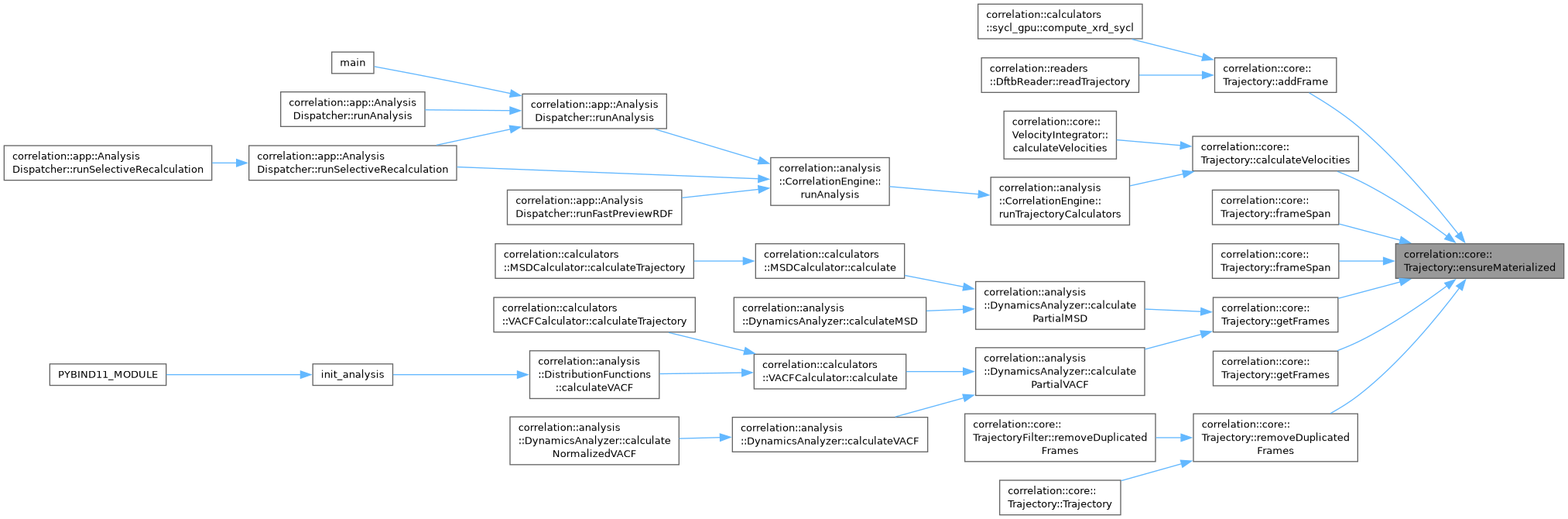
| void | ensureMaterialized () const |
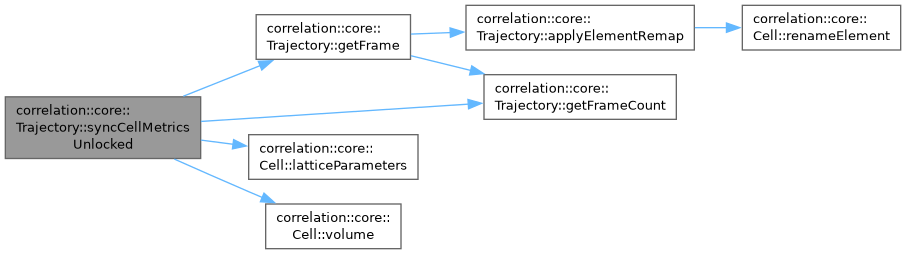
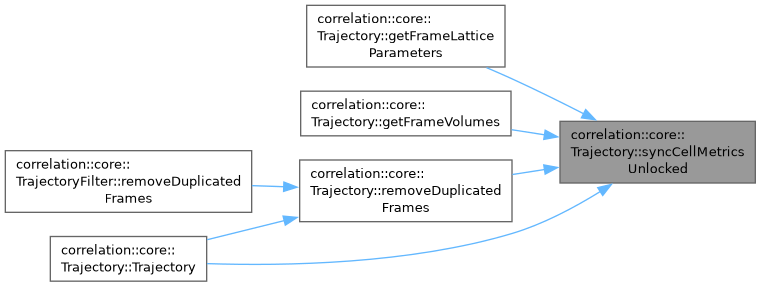
| void | syncCellMetricsUnlocked () const |
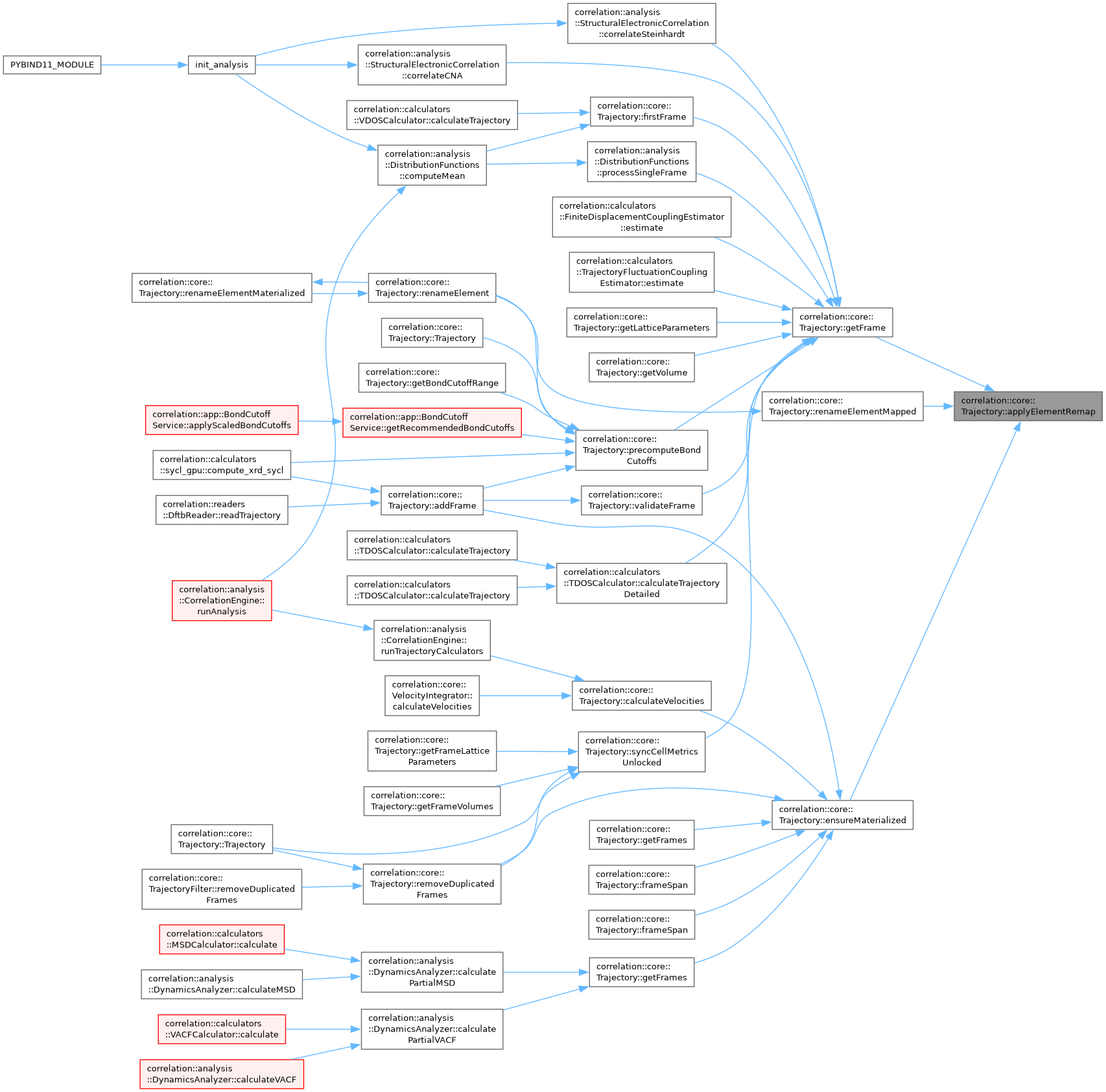
| void | applyElementRemap (Cell &cell) const |
| bool | renameElementMaterialized (std::string_view old_symbol, std::string_view new_symbol) |
| bool | renameElementMapped (std::string_view old_symbol, std::string_view new_symbol) |
Private Attributes | |
| std::unique_ptr< std::mutex > | init_mutex_ {std::make_unique<std::mutex>()} |
| std::vector< Cell > | frames_ |
| Collection of simulation snapshots. | |
| std::optional< Cell > | first_frame_ |
| std::vector< std::array< real_t, 6 > > | frame_lattice_parameters_ |
| Tracked lattice parameters per cell. | |
| std::vector< real_t > | frame_volumes_ |
| Tracked volume per cell. | |
| correlation::analysis::BondCutoffMatrix | bond_cutoffs_ |
| Cached bond cutoff ranges. | |
| real_t | time_step_ |
| Time between snapshots. | |
| size_t | removed_frames_count_ {0} |
| Counter for deduplicated frames. | |
| std::vector< std::shared_ptr< MappedFile > > | mapped_files_ |
| std::vector< MappedFrameSlice > | frame_slices_ |
| FrameParser | parser_ |
| std::vector< std::pair< std::string, std::string > > | element_remap_ |
Constructors | |
| using | FrameParser = std::function<Cell(const char *data, size_t size)> |
| Trajectory () | |
| Trajectory (std::vector< Cell > frames, real_t time_step) | |
| Constructs a trajectory from a vector of frames. | |
| Trajectory (std::shared_ptr< MappedFile > mapped_file, std::vector< size_t > frame_offsets, FrameParser parser, real_t time_step) | |
| Constructs a lazy-loading trajectory from a memory-mapped file. | |
| Trajectory (std::vector< std::shared_ptr< MappedFile > > mapped_files, std::vector< MappedFrameSlice > frame_slices, FrameParser parser, real_t time_step) | |
| Constructs a lazy-loading trajectory from multiple memory-mapped files. | |
| void | addFrame (const Cell &frame) |
| Appends a new frame to the trajectory. | |
Detailed Description
This class stores a series of snapshots of a system.
It ensures that the number of atoms and their identities are consistent across all frames. It provides methods to analyze dynamic properties of the system, such as velocity distributions.
Member Typedef Documentation
◆ FrameParser
| using correlation::core::Trajectory::FrameParser = std::function<Cell(const char *data, size_t size)> |
Constructor & Destructor Documentation
◆ Trajectory() [1/4]
| correlation::core::Trajectory::Trajectory | ( | ) |

◆ Trajectory() [2/4]
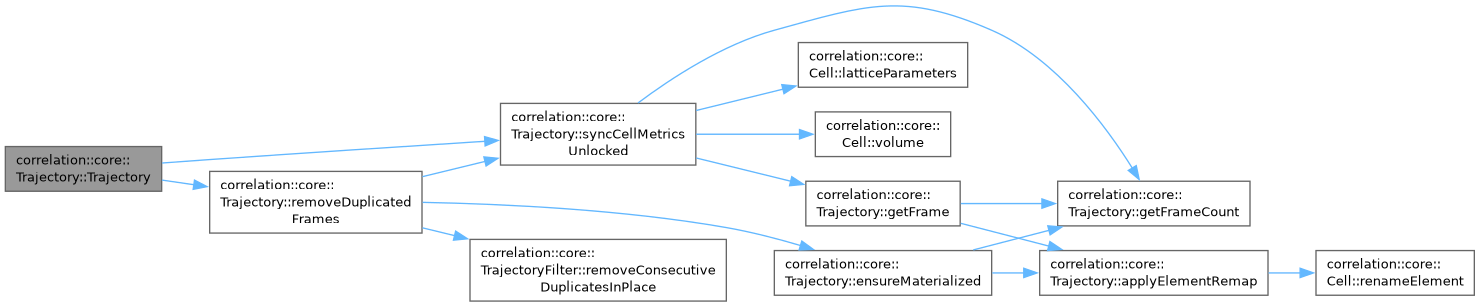
Constructs a trajectory from a vector of frames.
- Parameters
-
frames Vector of Cell objects representing simulation snapshots. time_step The time interval between consecutive frames.
◆ Trajectory() [3/4]
| correlation::core::Trajectory::Trajectory | ( | std::shared_ptr< MappedFile > | mapped_file, |
| std::vector< size_t > | frame_offsets, | ||
| FrameParser | parser, | ||
| real_t | time_step ) |
Constructs a lazy-loading trajectory from a memory-mapped file.
- Parameters
-
mapped_file Shared pointer to the mapped file. frame_offsets Byte offsets of the frames in the file. parser Function to parse a frame from a slice of memory. time_step The time interval between consecutive frames.

◆ Trajectory() [4/4]
| correlation::core::Trajectory::Trajectory | ( | std::vector< std::shared_ptr< MappedFile > > | mapped_files, |
| std::vector< MappedFrameSlice > | frame_slices, | ||
| FrameParser | parser, | ||
| real_t | time_step ) |
Constructs a lazy-loading trajectory from multiple memory-mapped files.
- Parameters
-
mapped_files Vector of shared pointers to mapped files. frame_slices Slice descriptors locating each frame across the mapped files. parser Function to parse a frame from a slice of memory. time_step The time interval between consecutive frames.

Member Function Documentation
◆ addFrame()
| void correlation::core::Trajectory::addFrame | ( | const Cell & | frame | ) |
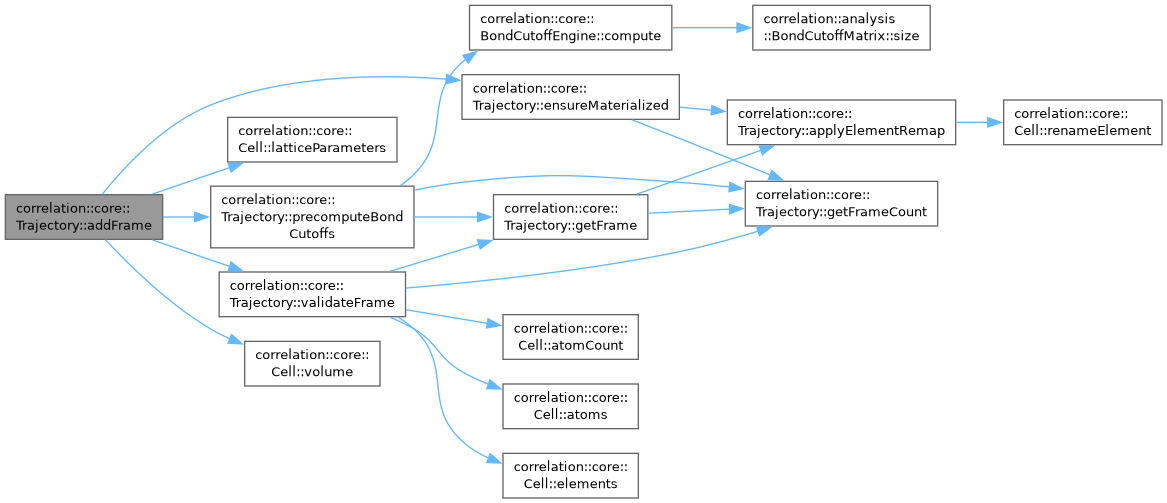
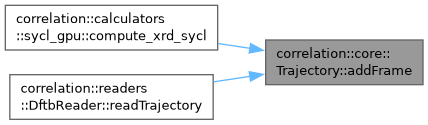
Appends a new frame to the trajectory.
- Parameters
-
frame The Cell object to add.
◆ applyElementRemap()
|
private |

◆ calculateVelocities()
| void correlation::core::Trajectory::calculateVelocities | ( | ) |
Calculates velocities for all atoms in the trajectory using finite differences, accounting for periodic boundary conditions. Assumes constant time step. Populates the internal velocities_ vector.


◆ ensureMaterialized()
|
private |

◆ firstFrame()
|
nodiscard |
Gets a constant reference to the first frame of the trajectory.
- Returns
- A Cell object representing the first frame.
- Exceptions
-
std::runtime_error if the trajectory is empty.


◆ frameSpan() [1/2]
|
nodiscard |
Gets a mutable span view over the trajectory frames.
- Returns
- Mutable span of Cell objects.

◆ frameSpan() [2/2]
|
nodiscard |
Gets an immutable span view over the trajectory frames.
- Returns
- Const span of Cell objects.

◆ getBondCutoff()
|
nodiscard |
Gets the maximum bond cutoff distance for two given element types.
- Parameters
-
type1 ID of the first element type. type2 ID of the second element type.
- Returns
- The bond cutoff distance.

◆ getBondCutoffRange()
|
nodiscard |
Gets the bond cutoff range for two given element types.
- Parameters
-
type1 ID of the first element type. type2 ID of the second element type.
- Returns
- Const reference to the BondCutoffRange.

◆ getBondCutoffs()
|
inlinenodiscardnoexcept |
Gets the matrix of bond cutoff ranges for element pairs.
- Returns
- The bond cutoff matrix.
◆ getBondCutoffSQ()
|
nodiscard |
Gets a squared bond cutoff distance for two given element types.
- Parameters
-
type1 ID of the first element type. type2 ID of the second element type.
- Returns
- The squared bond cutoff distance.

◆ getBondCutoffsSQ()
|
inlinenodiscardnoexcept |
Backward-compatible alias returning the bond cutoff matrix.
- Returns
- The bond cutoff matrix.

◆ getFrame()
|
nodiscard |
Gets a copy of a frame at a specific index.
- Parameters
-
index The index of the frame to retrieve.
- Returns
- A Cell object representing the frame.
- Exceptions
-
std::out_of_range if the index is invalid.

◆ getFrameCount()
|
nodiscardnoexcept |
Gets the total number of frames in the trajectory.
- Returns
- The number of frames.
◆ getFrameLatticeParameters()
|
nodiscard |
Gets the tracked lattice parameters [a, b, c, alpha, beta, gamma] for all frames.
- Returns
- Const reference to the per-cell lattice parameters vector.
◆ getFrames() [1/2]
|
nodiscard |
Gets a mutable reference to the frames.
- Returns
- A vector of Cell objects representing the frames.

◆ getFrames() [2/2]
|
nodiscard |
Gets a constant reference to the frames.
- Returns
- A vector of Cell objects representing the frames.

◆ getFrameVolumes()
|
nodiscard |
Gets the tracked cell volumes for all frames.
- Returns
- Const reference to the per-cell volumes vector.
◆ getLatticeParameters()
|
nodiscard |
Gets the lattice parameters [a, b, c, alpha, beta, gamma] for a specific frame.
- Parameters
-
index The index of the frame to query.
- Returns
- Array of 6 lattice parameters (lengths in Angstroms, angles in degrees).
- Exceptions
-
std::out_of_range if the index is invalid.

◆ getMinBondCutoff()
|
nodiscard |
Gets the minimum bond cutoff distance for two given element types.
- Parameters
-
type1 ID of the first element type. type2 ID of the second element type.
- Returns
- The minimum bond cutoff distance.

◆ getMinBondCutoffSQ()
|
nodiscard |
Gets a squared minimum bond cutoff distance for two given element types.
- Parameters
-
type1 ID of the first element type. type2 ID of the second element type.
- Returns
- The squared minimum bond cutoff distance.

◆ getRemovedFrameCount()
|
inlinenodiscardnoexcept |
Returns the number of frames removed during deduplication.
- Returns
- Count of duplicate frames found and removed.
◆ getTimeStep()
|
inlinenodiscardnoexcept |
Gets the time step between frames.
- Returns
- The time step in simulation units.

◆ getVolume()
|
nodiscard |
Gets the simulation cell volume for a specific frame.
- Parameters
-
index The index of the frame to query.
- Returns
- Volume of the cell in cubic Angstroms.
- Exceptions
-
std::out_of_range if the index is invalid.
◆ precomputeBondCutoffs()
| void correlation::core::Trajectory::precomputeBondCutoffs | ( | ) | const |
Pre-calculates the squared bond cutoff distances for every pair of element types using the elements from the first frame.
◆ removeDuplicatedFrames()
| void correlation::core::Trajectory::removeDuplicatedFrames | ( | real_t | tolerance = static_cast<real_t>(1e-5) | ) |
Removes consecutive duplicated frames from the trajectory. Frames are considered duplicates if all atom positions are identical (within a small tolerance).
- Parameters
-
tolerance Euclidean distance threshold in Angstroms for position equivalence.
◆ renameElement()
| bool correlation::core::Trajectory::renameElement | ( | std::string_view | old_symbol, |
| std::string_view | new_symbol ) |
Renames an element species across all frames (both materialized and lazy-mapped) and recomputes bond cutoffs.
- Parameters
-
old_symbol Existing element symbol (e.g., "1"). new_symbol Replacement element symbol (e.g., "Cu").
- Returns
- True if the element was renamed, false otherwise.

◆ renameElementMapped()
|
private |


◆ renameElementMaterialized()
|
private |


◆ setBondCutoffs()
| void correlation::core::Trajectory::setBondCutoffs | ( | const correlation::analysis::BondCutoffMatrix & | cutoffs | ) |
Sets the bond cutoff matrix for neighbor searching.
- Parameters
-
cutoffs Matrix of bond cutoff ranges [type1][type2].
- Exceptions
-
std::invalid_argument If any cutoff bound is negative or min_sq > max_sq.

◆ setTimeStep()
|
inlinenoexcept |
Sets the simulation time step.
- Parameters
-
step Time step in femtoseconds.
◆ syncCellMetricsUnlocked()
|
private |
◆ validateFrame()
|
private |
Internal helper to validate that a new frame matches the trajectory topology.
- Parameters
-
new_frame The frame to check.
- Exceptions
-
std::invalid_argument if frame is inconsistent.

Member Data Documentation
◆ bond_cutoffs_
|
mutableprivate |
Cached bond cutoff ranges.
◆ element_remap_
|
private |
◆ first_frame_
|
mutableprivate |
◆ frame_lattice_parameters_
|
mutableprivate |
Tracked lattice parameters per cell.
◆ frame_slices_
|
private |
◆ frame_volumes_
|
mutableprivate |
Tracked volume per cell.
◆ frames_
|
mutableprivate |
Collection of simulation snapshots.
◆ init_mutex_
|
mutableprivate |
◆ mapped_files_
|
private |
◆ parser_
|
private |
◆ removed_frames_count_
|
private |
Counter for deduplicated frames.
◆ time_step_
|
private |
Time between snapshots.
The documentation for this class was generated from the following files:
- include/core/Trajectory.hpp
- src/core/Trajectory.cpp