Loading...
Searching...
No Matches
correlation::core::gpu::DeviceBuffer< T > Class Template Reference
RAII wrapper for a typed GPU device allocation. More...
#include <DeviceBuffer.hpp>
Public Member Functions | |
| DeviceBuffer ()=default | |
| DeviceBuffer (std::size_t count) | |
Allocates device memory for count elements of type T. | |
| ~DeviceBuffer () | |
| DeviceBuffer (DeviceBuffer &&other) noexcept | |
| DeviceBuffer & | operator= (DeviceBuffer &&other) noexcept |
| DeviceBuffer (const DeviceBuffer &)=delete | |
| DeviceBuffer & | operator= (const DeviceBuffer &)=delete |
| void | copyFromHost (const T *host_data, std::size_t num_elements) |
| Copies host data to this device buffer. | |
| void | copyToHost (T *host_data, std::size_t num_elements) const |
| Copies device data back to a host buffer. | |
| void | setScalar (const T &value) |
| Sets the entire buffer to a value via host-to-device copy of a single element. | |
| T * | get () noexcept |
| Returns the raw device pointer. | |
| const T * | get () const noexcept |
| Returns the raw device pointer (const overload). | |
| std::size_t | size () const noexcept |
| Returns the number of allocated elements. | |
Private Member Functions | |
| void | release () noexcept |
Private Attributes | |
| T * | ptr_ {nullptr} |
| std::size_t | count_ {0} |
Detailed Description
template<typename T>
class correlation::core::gpu::DeviceBuffer< T >
RAII wrapper for a typed GPU device allocation.
Allocates device memory on construction and releases it on destruction. Move-only — cannot be copied. Replaces raw hipMalloc/hipFree pairs to guarantee exception-safe cleanup.
- Template Parameters
-
T Element type stored in the device buffer.
Constructor & Destructor Documentation
◆ DeviceBuffer() [1/4]
template<typename T>
|
default |
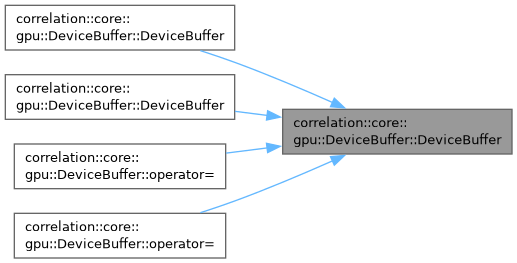
Here is the caller graph for this function:
◆ DeviceBuffer() [2/4]
template<typename T>
|
inlineexplicit |
Allocates device memory for count elements of type T.
- Parameters
-
[in] count Number of elements to allocate.
- Exceptions
-
GPUError If the device allocation fails.
Here is the call graph for this function:

◆ ~DeviceBuffer()
template<typename T>
|
inline |
Here is the call graph for this function:

◆ DeviceBuffer() [3/4]
template<typename T>
|
inlinenoexcept |
Here is the call graph for this function:

◆ DeviceBuffer() [4/4]
template<typename T>
|
delete |
Here is the call graph for this function:

Member Function Documentation
◆ copyFromHost()
template<typename T>
|
inline |
Copies host data to this device buffer.
- Parameters
-
[in] host_data Pointer to host source data. [in] num_elements Number of elements to copy (must be ≤ count_).
- Exceptions
-
GPUError If the memory copy fails.
Here is the call graph for this function:

◆ copyToHost()
template<typename T>
|
inline |
Copies device data back to a host buffer.
- Parameters
-
[out] host_data Pointer to host destination buffer. [in] num_elements Number of elements to copy (must be ≤ count_).
- Exceptions
-
GPUError If the memory copy fails.
Here is the call graph for this function:

◆ get() [1/2]
template<typename T>
|
inlinenodiscardnoexcept |
Returns the raw device pointer (const overload).
- Returns
- Const device pointer.
◆ get() [2/2]
template<typename T>
|
inlinenodiscardnoexcept |
Returns the raw device pointer.
- Returns
- Device pointer (may be nullptr if default-constructed or moved-from).
◆ operator=() [1/2]
template<typename T>
|
delete |
Here is the call graph for this function:

◆ operator=() [2/2]
template<typename T>
|
inlinenoexcept |
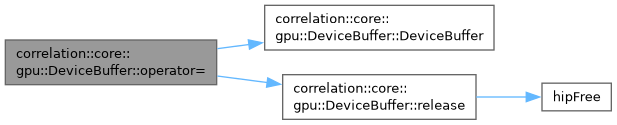
Here is the call graph for this function:
◆ release()
template<typename T>
|
inlineprivatenoexcept |
Here is the call graph for this function:

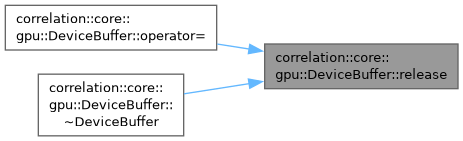
Here is the caller graph for this function:
◆ setScalar()
template<typename T>
|
inline |
Sets the entire buffer to a value via host-to-device copy of a single element.
- Parameters
-
[in] value The value to write (copied to device for the first element).
Here is the call graph for this function:

◆ size()
template<typename T>
|
inlinenodiscardnoexcept |
Returns the number of allocated elements.
- Returns
- Element count.
Member Data Documentation
◆ count_
template<typename T>
|
private |
◆ ptr_
template<typename T>
|
private |
The documentation for this class was generated from the following file:
- include/core/DeviceBuffer.hpp